|
| Before & After, Nave of Church |
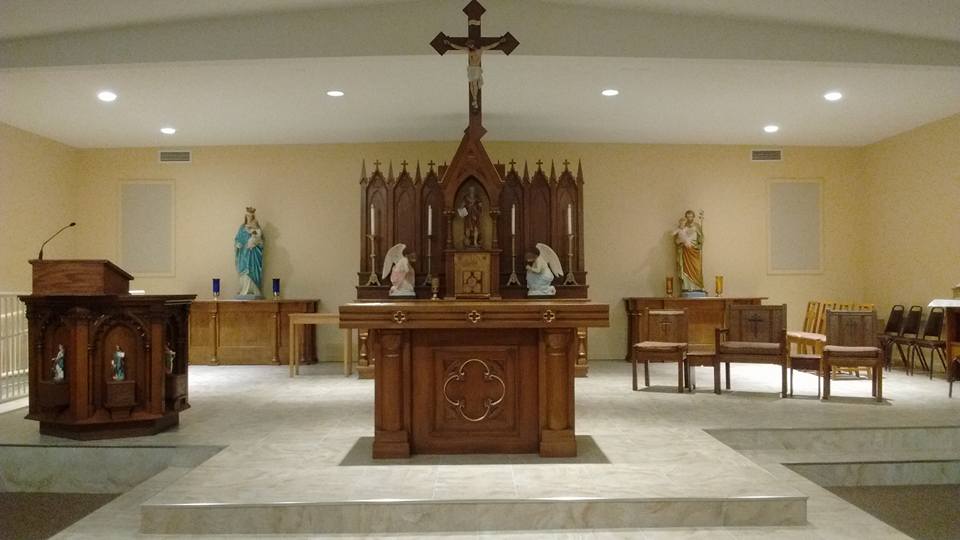
In the summer of 2013, Fr. Eric Schild approached Henninger's for ideas to renovate his parish, St. Jerome Church in Walbridge, a Church in the Diocese of Toledo. The Church building that Fr. Eric arrived to when he was appointed Pastor of St. Jerome's was a converted multi-purpose room with glass-block windows on the cinder block walls and a large heating vent running down the center of the ceiling. The sanctuary was also too small and not functional for Mass, so Fr. Eric and Henninger's began to collaborate on ideas to give the space more of a "church" feel and improve the aesthetics and functionality of the Church, all while staying within a budget.
 |
| Before & After, Sanctuary |
|
So as St. Jerome's began a capital campaign, Henninger's assisted Fr. Eric in utilizing some furniture from closed Churches from Canton to Cleveland to upstate New York in an attempt to re-use liturgical appointments while tying them together into a cogent - and liturgical - plan.

The first aspect of the project that they began to plan for was how to incorporate Stained Glass Windows in the side walls to eliminate the glass-block windows in the Church. Dealing with limitations set forth by the existing building, Henninger's and Fr. Eric found lancet windows that had been previously housed in Akron that added colors and religious symbols without being too large or ornate. The windows needed to be re-leaded and Henninger's recommended that the lancet windows be paired together and added to in order to create gothic arches that could adorn the side walls down the nave. A rendering was created for the congregation and the architect to review and the lancet windows were set aside for St. Jerome's with the idea that the work would be done as further plans were fleshed out and as the capital campaign continued.


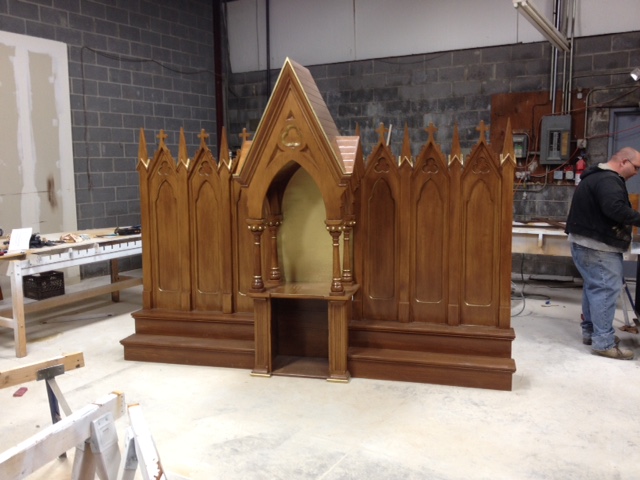
As the planning continued, Fr. Eric was able to find an Altar of Repose from a Church that had closed in upstate New York and Henninger's showed him an Ambo that had previously been in a since-closed Church in Lorain, Ohio. The styles of the two pieces matched very well and the richness of the stained wood of the Ambo was an appealing starting point for the other furniture, even if the Altar of Repose was originally painted an off-white color, which is how it arrived into Henninger's shop.

While continuing to find furniture that would complement these two main pieces (a baptismal font from Youngstown, an Altar of Sacrifice from Canton, among others), Fr. Eric was contacted by a Church in Fostoria, Ohio who told him that they had a set of Stations of the Cross that they were no longer using. Upon viewing them, Fr. Eric was thrilled as they were the large Stations that he had been looking for to adorn the side walls between the new Stained Glass windows and the colors complemented the colors of the Stained Glass windows that had been picked out. There was only one problem - there were only 13 Stations.

So Henninger's went to work finding a readily-available Station that could complement the rest of the set and - with a little work - could be modified to match the rest of the set. A replacement Station was found from a company in Chicago that specializes in fiberglass statues and Henninger's ordered the missing 8th Station. Upon the arrival of the Station, Henninger's went to work on a plan to modify it to match the rest of the Stations.
With the plans for the renovations being finalized by the Church, the architect, and the contractor, Henninger's began work on modifications to the pieces that had been accumulating for St. Jerome's over the previous two years. Their first project was on the Stations of the Cross and, most acutely, the modification of the "replacement" Station of the Cross. After completing the maintenance and repair work on 13 of the 14 Stations, which had been in a Church attic for decades, to get them back to nearly new condition, Henninger's devised a game-plan to fabricate a base for the "replacement" Station that would match the rest of the set. After the base was created, Henninger's cut the "replacement" Station to replicate the exact size of the rest of the set, then painted the Station as the rest of the set appeared to make the "replacement" Station blend seamlessly in with the rest of the set.
 |
| A mold is created to create a new base |
 |
| The new mold next to an existing Station |
 |
| A wood top is added to replicate the base's top |
 |
| Connecting the two components |
 |
| Painting to match |
 |
| Side-by-side of "replacement" and existing |
While the Stations of the Cross were being completed in the wood-shop and paint room, Henninger's artists went to work on the Stained Glass windows, repairing the old windows, modifying them to the new design, and readying them to transport to the now-being-renovated Church.
 |
| Windows being re-built to new size |
 |
| Windows taken apart |
 |
| Completed Bottom Panels |
 |
| Top Arches being completed |
 |
| Windows completed & ready for transport to St. Jerome Church |
 |
| Ambo color to match |
As the dedication date was set and work continued on-site with contractors, electricians, and plumbers, Henninger's continued to work on the liturgical appointments and furniture. With most of the furniture chosen and figured into the architectural plans, Henninger's faced the question of how to make all of the furniture match the richness of the wood Ambo, given that some of the pieces (the Altar of Repose, the Altar of Sacrifice, the Side Altars, and two pedestals) were all various shades of white or cream and some were actually made of plaster instead of wood. So, Henninger's went to work priming and painting all of the furniture so they would match the Ambo.
 |
| Base to the Altar of Repose, primed for paint |
 |
| Woodgrained Base to Altar of Repose |
 |
| Gold Accents Added to Base |
 |
| Top of Altar of Repose |
 |
| Completed Top Portion of Altar of Repose |
 |
| Woodgrained Sanctuary Furniture |
 |
|
| Furniture Ready for Delivery |
With most of the work completed and with the site readied for the liturgical aspects of the renovation, Henninger's loaded up the trailer to install the Stained Glass windows, the Stations of the Cross, and all of the Sanctuary furniture.


With the installation complete, the Church was readied for the dedication with the Bishop of the Diocese of Toledo, Most Rev. Daniel Thomas. As parishioners arrived, they could not believe the transformation of their Church, both in the Nave and the Sanctuary. With hard work, creativity, and resourcefulness, Henninger's and St. Jerome's had transformed the Church from a multi-purpose room with glass-block windows and a small Sanctuary to a space that looked more like a Church with a beautiful and functional Sanctuary.
 |
| Fr. Eric Schild speaks at the Dedication Mass |
 |
| Bishop Daniel Thomas at the Dedication Mass |


 As the planning continued, Fr. Eric was able to find an Altar of Repose from a Church that had closed in upstate New York and Henninger's showed him an Ambo that had previously been in a since-closed Church in Lorain, Ohio. The styles of the two pieces matched very well and the richness of the stained wood of the Ambo was an appealing starting point for the other furniture, even if the Altar of Repose was originally painted an off-white color, which is how it arrived into Henninger's shop.